Learning · 4 min
Revise Macbeth with one mind map.
Four branches, a dozen quotations and one rule: every quotation links to a theme. A step-by-step guide for GCSE students and the teachers revising with them.

Why one map is enough
GCSE questions on Macbeth usually begin with an extract and then ask you to write about the play as a whole. In the exam, you need to move quickly from one scene to the themes, characters and context it connects to. A set of separate notes makes that slow. One map puts all four in view at once.
The four branches also match what examiners reward: a personal response backed by quotations, analysis of Shakespeare’s language, and context that explains his choices.
Step 1: put the play at the centre
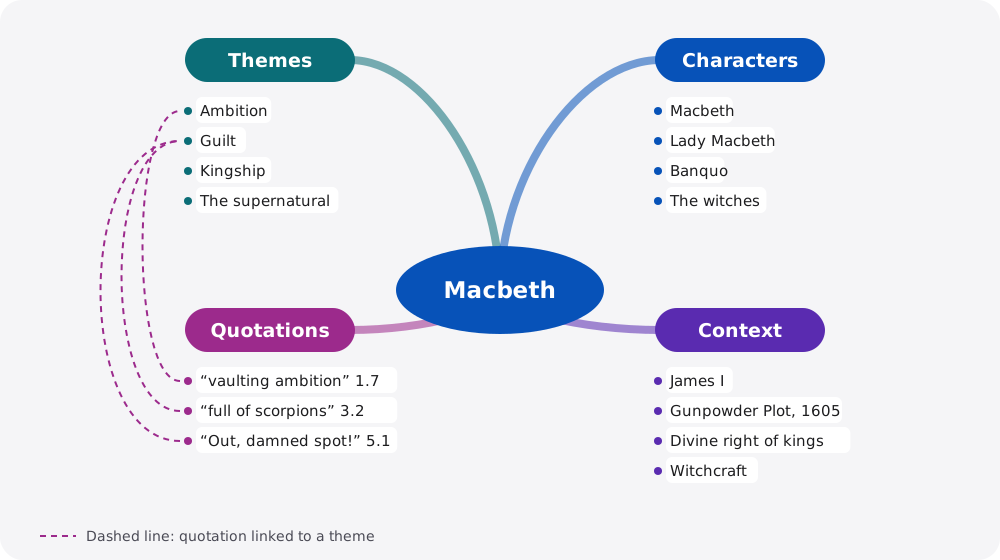
Write “Macbeth” in the middle of the page. Add four main branches: themes, quotations, characters and context. Leave space between them, because the most useful part of the map will be the lines that cross from one branch to another.
Step 2: choose four or five themes
Ambition, guilt, kingship and the supernatural cover most questions. Appearance and reality is a good fifth. Under each theme, write one short sentence of your own argument rather than a definition. “Ambition destroys the people who give in to it” is something you can argue with evidence. “Ambition means wanting power” is not.
Step 3: pick short quotations
Choose ten to fifteen quotations of two to five words each, and write the act and scene beside each one. Short quotations are easier to remember and easier to analyse word by word. For example:
- “Fair is foul, and foul is fair” (1.1)
- “Stars, hide your fires” (1.4)
- “unsex me here” (1.5)
- “vaulting ambition” (1.7)
- “full of scorpions is my mind” (3.2)
- “Out, damned spot!” (5.1)
- “Tomorrow, and tomorrow, and tomorrow” (5.5)
Now draw a line from each quotation to at least one theme. A quotation that links to no theme is either in the wrong place or not worth learning. A quotation that links to two themes is worth learning first.
Step 4: show how each character changes
For each main character, write where they start and where they end, with a quotation at each end if you can.
- Macbeth: “brave Macbeth” (1.2) becomes “this dead butcher” in the final scene.
- Lady Macbeth: she calls on spirits to “unsex me here” (1.5) and ends sleepwalking, unable to wash her hands clean (5.1).
- Banquo: he hears a prophecy too but does not act on it, which makes him a measure for Macbeth.
- The witches: they predict, but the play never says they decide. Note where you stand on that question.
Step 5: keep only the context that explains a choice
Context earns marks when it explains something in the play, not when it is a list of facts. Four points cover most answers:
- James I became the patron of Shakespeare’s company in 1603 and was believed to descend from Banquo, which helps explain why Banquo is shown so favourably.
- The Gunpowder Plot of 1605, a failed attempt to kill the king, was recent when the play was first performed, so killing a king would have felt close to home.
- The divine right of kings: a king was believed to be chosen by God, so Duncan’s murder is a crime against the natural order. Notice the storms and the strange behaviour of animals that follow it.
- Witchcraft: James wrote a book about it, Daemonologie (1597), and many in Shakespeare’s audience believed witches were real.
Step 6: revise from the map
Cover one branch and redraw it from memory, then compare it with the original. What you missed is what to revise next. Once the branches come back easily, practise with extracts: take any scene, find it on the map, and follow the lines to two themes and one context point. That is the plan for your answer, and it should take about five minutes.
If you teach the play, you can build the same map by hand in Foramind, present it branch by branch in a revision lesson and keep it in your library for next year’s class.