Mind mapping · 4 min
Mind map or concept map? How to choose for a lesson.
They look alike on the page but they answer different questions. One test tells you which to draw.

The short answer
Use a mind map when students need to see what belongs to a topic. Use a concept map when they need to explain how ideas affect each other.
The quickest test is to look at the lines. If every line needs a verb to make sense, such as “causes”, “turns into” or “depends on”, you need a concept map. If a line only means “is part of”, a mind map will do the job with less effort.
Where each one comes from
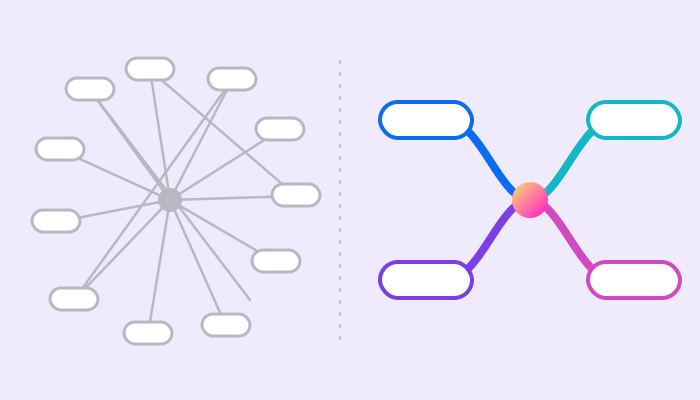
Tony Buzan popularised the mind map in the 1970s, most widely through his 1974 BBC series and book Use Your Head. A mind map has one central idea. Branches radiate from it, each carrying a single keyword, and colour and images help tell the branches apart.
Joseph Novak and his research team at Cornell University developed the concept map in 1972 to follow how children’s understanding of science changed over time. Their work drew on David Ausubel’s idea that new learning builds on what a learner already knows. In a concept map, ideas sit in boxes and every line carries a linking phrase. Two boxes and their link read as a statement: “water vapour condenses into clouds”. Concept maps are often arranged from general to specific, with cross-links between distant parts.
The same topic, drawn both ways
Here is the water cycle as a mind map and as a concept map.
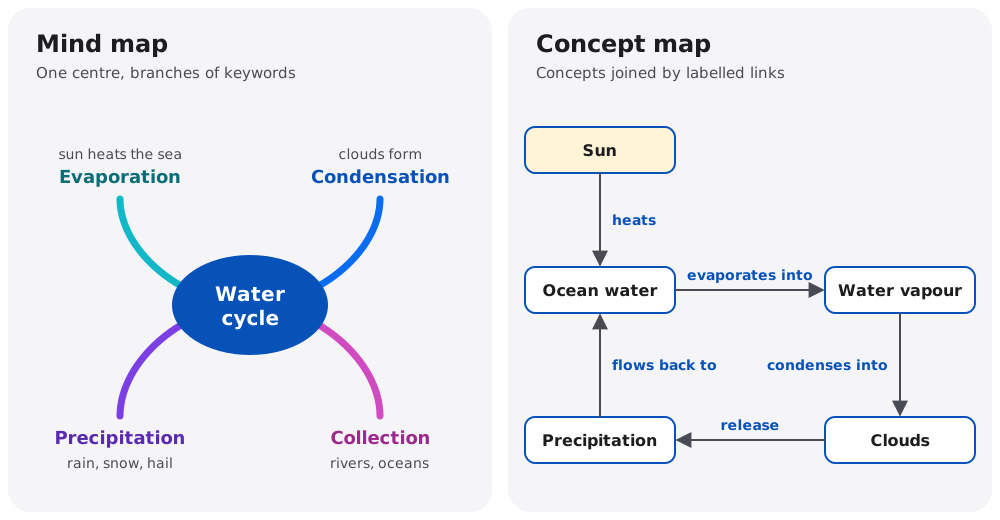
The mind map is quicker to draw and easier to scan. It tells you there are four stages. It does not tell you why they come in that order. The concept map is slower, but a student who can draw it can also explain it. Every arrow is a sentence they could say aloud.
When a mind map fits
- Introducing a new topic, so students see its parts before the detail.
- Collecting ideas quickly, in a class discussion or before writing.
- Planning an essay, with one branch per paragraph.
- Building a revision overview of a unit on one page.
- Taking notes while someone else is talking.
When a concept map fits
- Processes and cycles: the water cycle, photosynthesis, the carbon cycle.
- Causes and effects: the causes of a war, the effects of a price change.
- Checking for misconceptions. A wrong linking phrase shows a misunderstanding that a list of keywords would hide.
- Connecting two topics that students learnt separately.
Because each link is a statement, a concept map is also a good way to hear what a student thinks. Ask them to read their map aloud. You will spot a weak link faster than you would in a page of notes.
Use both in one unit
The two maps work well in sequence. Start a unit with a mind map to collect what belongs to the topic. Later, pick the branch students find hardest and turn it into a concept map: put its keywords in boxes and ask students to write a verb on every line.
A lighter version works too. Leave the mind map as it is and ask students to label three of its lines with a verb. The conversation that follows is often the most useful part of the lesson.
Foramind is built for mind maps. You can build one by hand, teach from it in class and keep it in your library for the next time you teach the unit.
Three common mistakes
- A concept map with unlabelled lines. Without linking phrases it is just boxes and arrows, and students can draw it without understanding it.
- A mind map with sentences on the branches. Keep one keyword per branch. If a branch needs a sentence, it may be a concept map in disguise.
- Too many ideas on one map. Twelve to fifteen ideas is plenty for one lesson. Move the rest to a second map.